What Every Yogi Should Know About Hands-On Assists


Hands on adjustments, also called manual assists are a longstanding component of many yoga traditions. From Iyengar to Ashtanga, teachers have used tactile cueing to refine alignment, deepen embodiment, and guide students safely into postures. However, contemporary conversations around consent, trauma awareness, and injury prevention have prompted a critical re-evaluation of this practice.
This article examines the advantages and limitations of hands-on adjustments and outlines best practices for teachers navigating this nuanced terrain.
What Are Hands-On Adjustments?
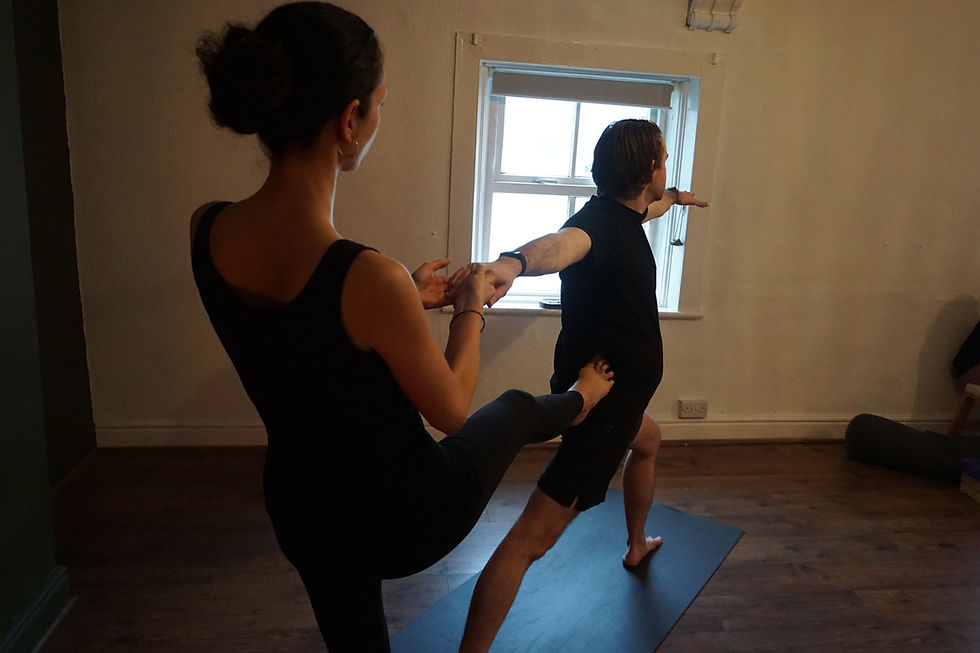
Hands on adjustments involve a teacher physically touching a student to modify alignment, increase stability, enhance muscular engagement, or deepen a pose. They may be subtle (a light cue at the sacrum in Tadasana) or more directive (assisting hip rotation in Trikonasana).
Adjustments generally fall into three categories:
Alignment corrections Guiding joints into safer or more biomechanically efficient positions.
Stabilising assists Providing grounding or support to improve balance and proprioception.
Depth enhancements Encouraging greater range of motion or intensity.
The Pros of Hands-On Adjustments
1. Enhanced Proprioceptive Awareness
Verbal cues often fail to translate into embodied understanding. Tactile input can immediately clarify spatial orientation and muscular engagement. For many students, feeling the adjustment creates faster neuromuscular integration than hearing instructions alone.
2. Improved Biomechanical Alignment
Strategic manual cueing can reduce compensatory patterns and joint stress. For example:
Encouraging external rotation in the hip without collapsing the knee.
Lengthening the spine while preventing rib flaring.
Supporting scapular stabilization in weight-bearing poses.
When skillfully applied, adjustments can reduce injury risk rather than increase it.
3. Nervous System Regulation
Safe, intentional touch can activate parasympathetic responses. In restorative or yin settings, gentle assists may enhance relaxation and interoceptive awareness.
4. Individualized Instruction in Group Settings
In large classes, verbal cueing must remain generalized. Hands-on assists allow teachers to tailor corrections without interrupting the collective flow.
5. Increased Teacher, Student Trust (When Consent Is Clear)
When boundaries are respected, appropriate touch can reinforce relational trust and attentiveness.
The Cons of Hands-On Adjustments
1. Consent and Trauma Sensitivity
Not all students are comfortable with physical contact. Trauma survivors may experience touch as destabilizing, even if the intent is benign. Without explicit, informed consent, adjustments can violate personal boundaries.
2. Risk of Injury
Improperly executed adjustments can:
Force range of motion beyond safe limits
Compress vulnerable joints (e.g., lumbar spine, cervical spine, knees)
Override a student’s proprioceptive safety mechanisms
Aggressive “deepening” adjustments are particularly high-risk.
3. Power Dynamics
Yoga teachers occupy positions of authority. A student may not feel empowered to decline touch in a group environment. This dynamic can blur autonomy.
4. Dependence on External Feedback
Over-reliance on manual adjustments may inhibit a student’s ability to self-regulate and internalize alignment cues.
5. Legal and Ethical Liability
Inadequate training, ambiguous consent policies, or unclear boundaries can create legal exposure for instructors and studios.
When Hands-On Adjustments May Be Appropriate
The student has given explicit, ongoing consent.
The teacher has advanced anatomical training.
The assist enhances safety rather than intensity.
The student demonstrates readiness for tactile cueing.
Clear communication precedes and accompanies touch.
Best Practices for Modern Teaching
Obtain Explicit Consent Use opt-in systems (verbal consent, consent cards, intake forms). Normalize declining.
Describe Before You Touch Briefly explain what you intend to adjust and why.
Prioritize Stability Over Depth Focus on joint stacking and muscular engagement rather than increasing stretch.
Use Minimal Effective Pressure Adjustments should guide, not force.
Offer Verbal and Demonstrative Alternatives Ensure students can achieve similar benefits without touch.
Continue Education Study anatomy, biomechanics, and trauma-informed teaching methodologies.
A Shifting Culture
The yoga industry has evolved significantly over the past decade. Many studios now default to verbal cueing and offer hands-on assists only upon request. This shift reflects broader cultural awareness around autonomy and bodily agency.
The essential question is no longer “Should teachers use hands-on adjustments?” but rather:
Can the teacher ensure that touch is consensual, skillful, necessary, and beneficial?
When the answer is yes, manual assists can remain a valuable pedagogical tool. When the answer is uncertain, restraint is often the more ethical choice.
Hands-on adjustments are neither inherently beneficial nor inherently harmful. Their value depends on context, consent, competency, and intention.
In modern yoga teaching, refinement is less about how deeply a student moves into a posture and more about how safely and autonomously they inhabit it.


Comments